
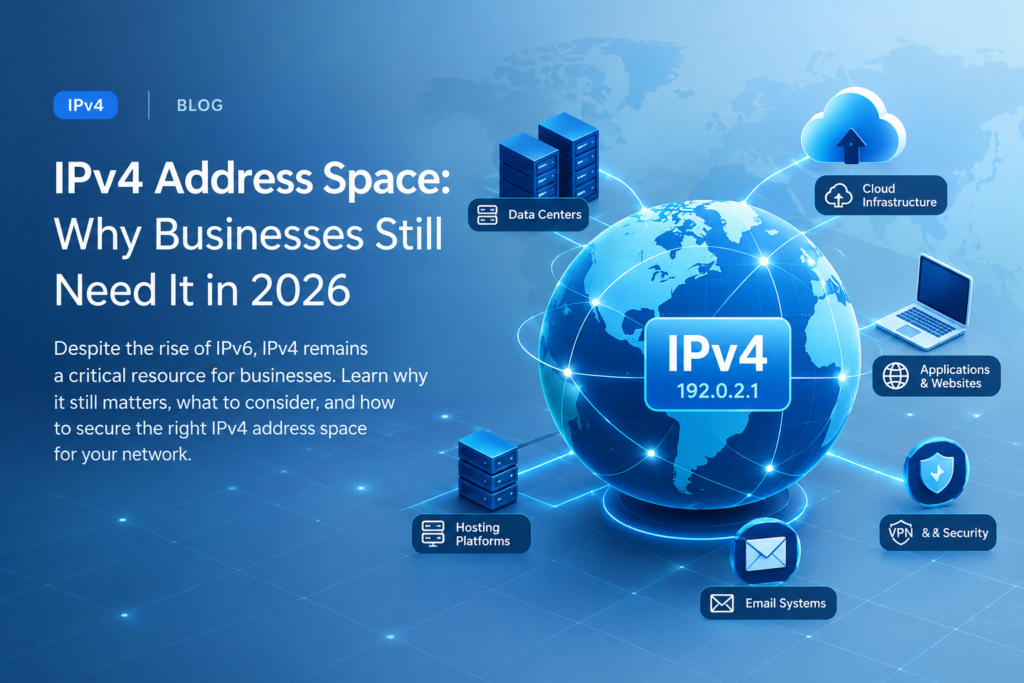
IPv4 remains one of the most important resources for businesses operating online. Despite the continued adoption of IPv6, organizations around the world still rely heavily on IPv4 for websites, applications, cloud infrastructure, hosting platforms, VPNs, proxies, email systems, and network connectivity.
As the supply of IPv4 addresses has become increasingly limited, businesses often need to look beyond traditional allocations and consider buying or leasing IPv4 address space to support their infrastructure.
What Is IPv4?
IPv4, or Internet Protocol version 4, is the addressing system used to identify devices and networks on the Internet. It uses 32-bit addresses, providing approximately 4.3 billion unique addresses.
An IPv4 address looks like:
192.0.2.1
IPv4 has been the foundation of Internet connectivity for decades, but the available address pool is finite.
Why Is IPv4 Still Important?
The growth of cloud services, data centers, SaaS platforms, hosting providers, VPN networks, and connected devices has continued to increase demand for Internet addresses.
Many existing systems and networks still depend on IPv4 compatibility. Although IPv6 provides a much larger address space, transitioning infrastructure does not happen overnight.
For businesses, maintaining access to reliable IPv4 resources can therefore remain an important part of network planning.
IPv4 Scarcity Has Changed the Market
Regional Internet Registries (RIRs) have largely exhausted their available pools of IPv4 addresses. As a result, organizations that require additional IPv4 resources may explore the secondary IPv4 market.
Businesses may choose to:
- Buy IPv4 for long-term ownership and infrastructure requirements
- Lease IPv4 when they need flexible access without purchasing address space
- Sell IPv4 when they have unused or surplus resources
- Plan IPv6 adoption alongside their existing IPv4 infrastructure
The right approach depends on an organization’s network requirements, budget, growth plans, and technical environment.
What Should You Consider Before Buying IPv4?
Buying IPv4 address space involves more than simply selecting a block size. Businesses should evaluate several factors before completing a transaction.
1. RIR Region
IPv4 resources are associated with Regional Internet Registries such as:
- RIPE NCC
- ARIN
- APNIC
- LACNIC
- AFRINIC
The appropriate registry and transfer process depend on the address space and the organizations involved.
2. Block Size
IPv4 resources can be available in different prefix sizes, such as:
- /24
- /23
- /22
- /21
- /20
- Larger blocks
Your infrastructure requirements should determine the appropriate size rather than purchasing more address space than necessary.
3. Registration & Transfer Requirements
IPv4 transactions may involve registry policies, documentation, verification, and transfer procedures. Understanding these requirements before committing to a transaction can help avoid unnecessary delays.
4. Address History
Businesses should also consider the history and current status of an IPv4 block. Relevant factors can include registration information, routing history, and potential reputation considerations depending on how the addresses will be used.
Buying vs. Leasing IPv4
Buying and leasing serve different business requirements.
Buying IPv4 can make sense for organizations that need address space for long-term infrastructure and want to maintain ownership of the resources.
Leasing IPv4 can be useful when a business needs additional addresses for a specific project, temporary expansion, or flexible infrastructure deployment without making a larger upfront purchase.
Neither option is universally better—the appropriate choice depends on your operational requirements and long-term strategy.
The Role of IPv6
IPv6 is essential for the long-term growth of the Internet because it provides an enormous address space compared with IPv4.
However, IPv6 adoption does not immediately eliminate the need for IPv4. Many businesses continue to operate dual-stack environments or use technologies that allow IPv4 and IPv6 networks to work together.
A practical strategy for many organizations is therefore to manage existing IPv4 requirements while progressively preparing for IPv6.
Final Thoughts
IPv4 remains a valuable and widely used Internet resource. As availability becomes more limited, businesses need to approach IPv4 acquisition, leasing, and management strategically.
Whether you are expanding a hosting platform, launching a new network, scaling cloud infrastructure, or planning your transition toward IPv6, understanding your IP requirements can help you make better infrastructure decisions.
At Atlas IP Group, we help organizations navigate IPv4 buying, selling, leasing, IPv6 solutions, and IP strategy across the global RIR ecosystem.